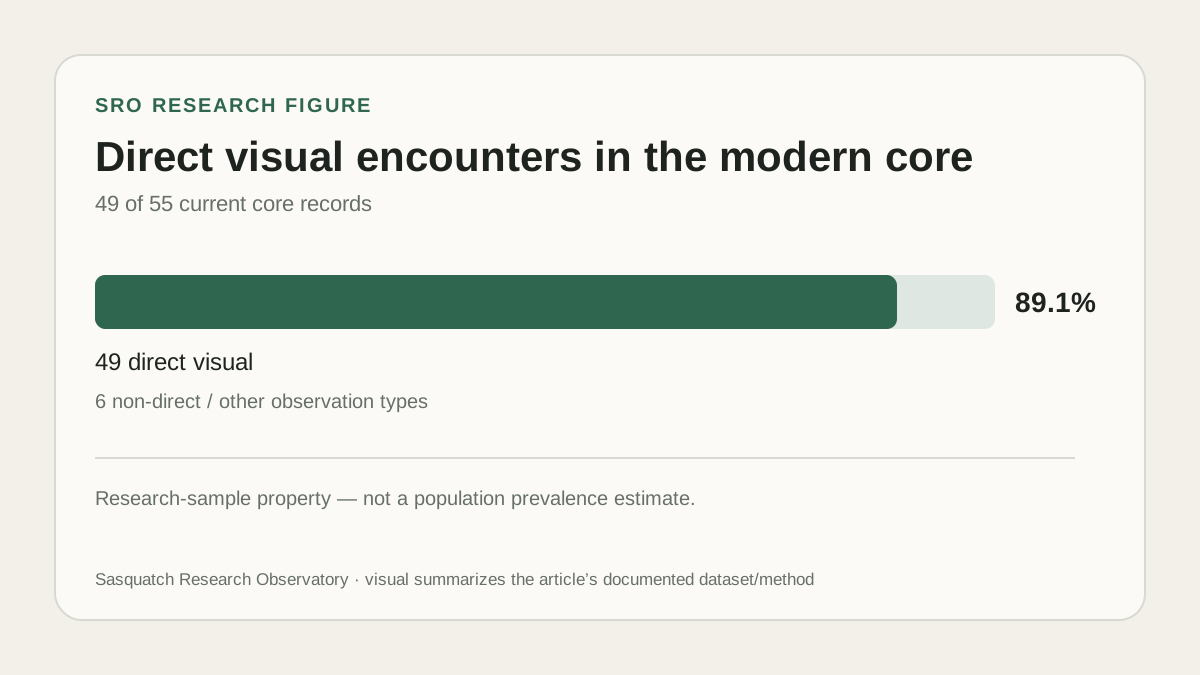
A basic question sits underneath almost every argument about Sasquatch testimony: are the people in a research collection mostly describing something they say they actually saw, or are the records dominated by sounds, impressions, secondhand stories and interpretation? In SRO’s current modern core, the answer is unusually clear. Forty-nine of 55 coded witnesses are direct-visual records.
Scope of this publication
- Sample: 55 deduplicated modern core witness records.
- Usable coverage: all 55 core records were coded for direct-visual status in this analysis.
- Primary calculation: 49/55 direct visual = 89.1%.
- High-strangeness exclusion: 40/42 direct visual = 95.2%.
- Researcher + high-strangeness exclusion: 32/34 direct visual = 94.1%.
- Longitudinal matrix checkpoints: 31/36; 44/50; 48/54; 49/55.
- Source mix: qualified modern witness records assembled across multiple source ecosystems; source quality does not substitute for witness qualification.
- Independence: witness entities are deduplicated, but cultural independence among witnesses is not assumed or established.
- Limitation: selected research core; not population prevalence or authentication of the claims.
- Reproducibility: modern-matrix denominator audit plus the published stage counts above.
The signal stayed stable as the dataset grew
The useful part of the result is not simply the final 49-of-55 count. Earlier stages of the same modern matrix produced 31 direct-visual records among 36 core witnesses, then 44 of 50, 48 of 54 and finally 49 of 55. The proportion therefore remained in a narrow range as new qualified records were added rather than appearing only in the smallest seed sample. That does not prove the reports are accurate. It shows that the modern core, as constructed, is consistently dominated by firsthand visual claims rather than by nonvisual or purely interpretive material.
What happens when we remove obvious contamination concerns?
SRO also ran sensitivity tests designed to ask whether the visual pattern disappears when potentially complicating records are removed. After excluding high-strangeness cases, 40 of 42 retained modern records were direct visual. In a further filtered cohort excluding both high-strangeness and researcher-heavy records, 32 of 34 were direct visual. These filters do not eliminate every selection effect, cultural influence or witness-quality problem. They test a narrower proposition: the visual character of the modern core is not being created solely by those two categories.
Why this matters
This changes the next research question. If the modern collection were mostly nonvisual, analysis of reported morphology would rest on a weak foundation. Because most core records are visual claims, SRO can instead ask whether the descriptions themselves converge, how stable they remain over time, and which traits can be traced to early sources.
What this does not mean
The 89.1% figure is not the percentage of all Sasquatch reports that are visual, and it is not evidence that 89.1% of witnesses saw a real animal. The Observatory’s core is a deliberately qualified research sample. Its inclusion rules favor records useful for source-auditable analysis. The result describes that sample and nothing larger.
Inspect the underlying work
- Dataset: Modern witness matrices / 55-witness core
- Audit: sasquatch_key_findings_analysis_2026 + paranormal stress test
- Finding status: Supported within the coded core
- Reproducibility: Ranked Findings #1–2 and denominator audit