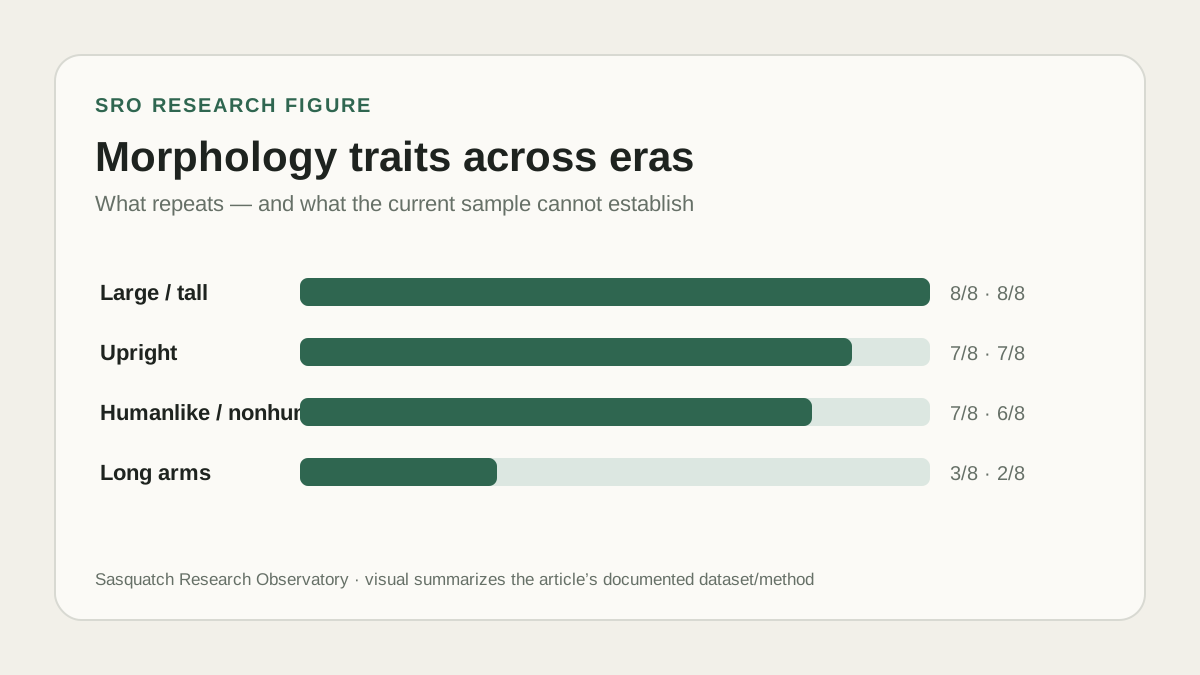
Long arms and a neck that seems to disappear into the shoulders are familiar parts of the modern Sasquatch image. The useful question is not whether those traits are popular today, but whether we can trace them to source-linked witnesses from different periods. In the Observatory's current verified morphology subset, we can—but only for a narrow set of records, and not yet in a way that supports population-wide percentages.
Inspect the underlying media
These source items are tied to witness or case records cited in this publication. They are provided for inspection and remain separate from the article’s analysis.
Open original source
Original source
Source material associated with this witness record. Inclusion documents the source trail and does not authenticate the underlying claim.
Open original source ↗William Roe 1957 sworn affidavit reproduction
Sasquatch Chronicles
Document scan connected to this witness record. It is presented as documentation, not as independent authentication of the reported event.
Open original source ↗Scope of this publication
- Analytical sample used here: 4 named witness records discussed in the finding.
- Source anchors: 5 exact locator records (LOC-0001, LOC-0002, LOC-0012, LOC-0013, LOC-0016).
- Coverage warning: this is a selected exact-locator morphology subset, not a representative sample of the 127-profile public archive.
- Independence warning: source-linked records reduce summary contamination but do not prove cultural independence between witnesses.
- Reproducibility: findings ANL-4.5-001, ANL-4.5-002 and ANL-4.5-005.
Long arms appear in records separated by decades
William Roe's recovered 1957 statement describes arms longer than a man's and reaching almost to the knees. Oregon National Guard witness Todd Neiss later described arms extending well past the knees in a firsthand account published in 2007. A separate firsthand interview with Kerry Arnold describes very long arms and massive forearms.
The value of the comparison is chronological and documentary: the trait can be located in source-linked testimony from different eras. It does not establish that the witnesses observed the same kind of subject, and it does not tell us how frequent the trait is across the full archive.
The 'no neck' description survives the same test
Roe described a short, thick neck. Neiss reported no visible neck. Modern witness Kevin Frankenfield also described no visible neck in a separate firsthand account. SRO groups these as a descriptive family rather than treating the phrases as anatomically identical; wording, distance, angle and viewing conditions differ.
What this finding actually adds
Bigfoot descriptions are often repeated through books, television, podcasts and internet culture. Source-linked comparison lets us ask a more disciplined question: can a familiar trait be demonstrated in the testimony itself rather than only in later summaries? For long arms and a reduced-or-obscured neck, the present verified records say yes.
That makes these traits legitimate targets for a larger analysis layer. As more accounts receive normalized morphology coding and exact provenance, SRO can test whether the apparent continuity survives a broader, less selectively detailed sample.
What the data cannot support yet
The present subset was assembled partly because the records contain useful descriptive detail. It is therefore not representative of all 127 public witness profiles. An account that does not mention arm length or a neck cannot be counted as evidence that the trait was absent. Those two limits make prevalence percentages premature.
The publishable finding is deliberately narrower: these descriptive families occur in recoverable, source-linked testimony in both historical and modern records. Anything stronger awaits broader coding.
Inspect the underlying work
- Finding IDs: ANL-4.5-001, ANL-4.5-002, ANL-4.5-005
- Witness records: William Roe, Todd Neiss, Kerry Arnold, Kevin Frankenfield
- Exact locators: LOC-0001, LOC-0002, LOC-0012, LOC-0013, LOC-0016
- Status: supported in the current verified subset; no prevalence or species-level inference