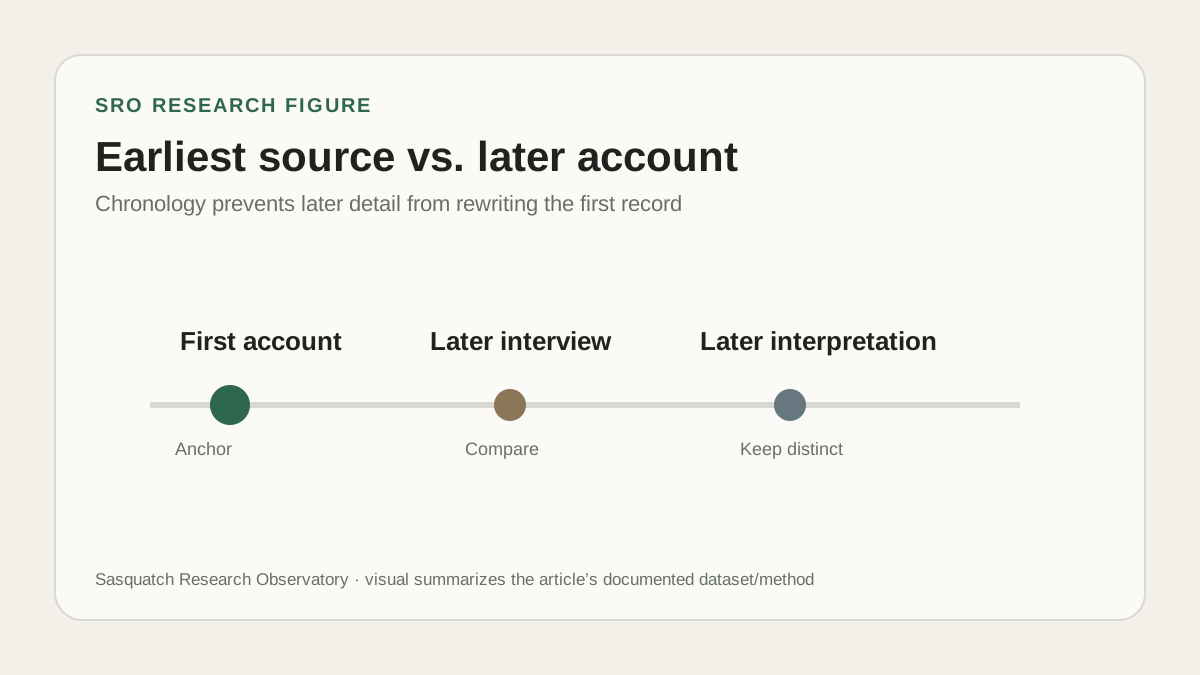
The version of a famous encounter most people know is often the version told years later. That creates a research problem: later interviews may contain useful detail, but they can also make it difficult to see what was actually on the record near the beginning. SRO's chronology system treats the earliest recoverable account as an anchor and later testimony as a sequence of additions, changes and confirmations—not as one blended story.
Inspect the underlying media
These source items are tied to witness or case records cited in this publication. They are provided for inspection and remain separate from the article’s analysis.
Open original source
Original source
Source material associated with this witness record. Inclusion documents the source trail and does not authenticate the underlying claim.
Open original source ↗
Bob Gimlin at Patterson/Gimlin Film Site Interview (Short Version)
Tate Hieronymus / Bluff Creek Project
Video associated with this witness record. Source access is preserved separately from evidentiary assessment.
Open original source ↗Scope of this publication
- This is a methodological publication illustrated with 3 archive examples; it is not a prevalence study.
- Exact source anchors used in the examples include LOC-0004 and LOC-0022; additional chronology work remains open.
- Comparison rule: earliest recoverable source is the anchor; later silence is not contradiction; later-added detail remains later unless earlier support is recovered.
- Reproducibility: finding ANL-4.5-004 plus each witness's dated source chronology.
Why the first recoverable account gets special weight
An early source is not automatically accurate, complete or truthful. Its value is different: it fixes a claim at a particular point in time. Once that checkpoint exists, later statements can be compared against something more concrete than memory about what the witness 'always said.'
Three archive examples show why this matters
Todd Neiss's earlier published account preserves substantial morphology from his 1993 Oregon encounter, while later research context remains chronologically separate. In the Missouri 'MoMo' record, a recovered state transcript reading from a 1972 clipping preserves a narrower description than some later retellings. Bob Gimlin's radio testimony recorded six days after the Patterson-Gimlin event provides an unusually early checkpoint that can be compared with interviews given decades later.
These examples do not all show contradiction. They show why chronology must be preserved before interpretation begins.
Added later is not the same as contradicted
People omit details. Interviewers ask different questions. Memory can be prompted by context. For that reason, SRO codes a detail that first appears later as 'added later' unless an earlier statement actually conflicts with it. Silence is not contradiction.
That conservative rule protects both directions of the analysis: later material is not automatically dismissed, and it is not silently backdated into an earlier account.
The larger research opportunity
Once enough witnesses have two or more well-dated source points, the Observatory can move beyond individual examples. It can measure how often core event descriptions remain stable, what kinds of details tend to appear later, and whether particular source environments are associated with more narrative growth. The current article establishes the method; a larger longitudinal dataset is still being built.
What remains unresolved
Some earliest sources remain unrecovered, and publication date is not the same as encounter date. A newly discovered clipping or recording can move the earliest known checkpoint backward. The chronology must therefore remain revisable while preserving every source version already documented.
Inspect the underlying work
- Finding ID: ANL-4.5-004
- Example witnesses: Todd Neiss, Doris Harrison / MoMo record context, Bob Gimlin
- Exact locators include LOC-0004 and LOC-0022
- Status: methodological control established; larger longitudinal analysis awaits broader source recovery