A seven-foot figure, long arms, upright movement, an unusual head and a body that looks humanlike without being described as human: modern Sasquatch imagery is familiar. The harder question is whether similar descriptions can be recovered from older records without letting famous cases or repeated retellings dominate the comparison.
Scope of this publication
- Unit of analysis: unique encounter/event, not witness.
- Historical morphology-rich events: N=8.
- Modern morphology-rich events: N=8.
- Usable coverage: 16 event records selected because morphology was sufficiently recoverable for this seed comparison.
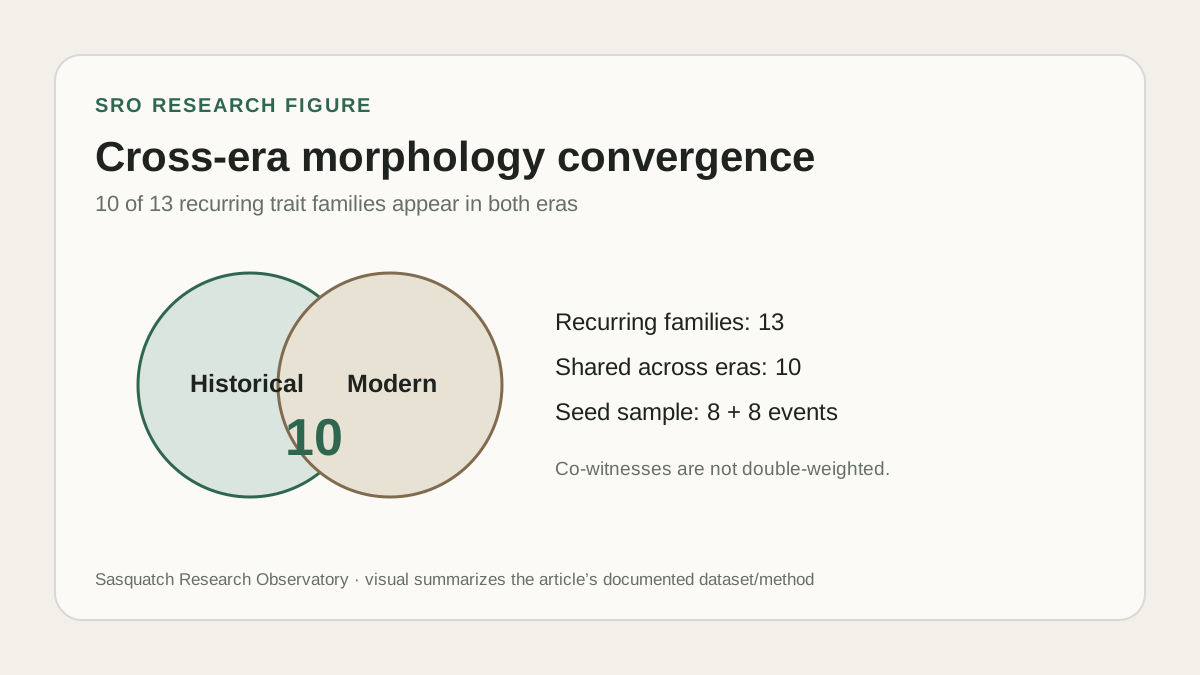
- Recurring trait families (≥2 in either cohort): 13.
- Recurring in both cohorts: 10/13 = 76.9%.
- Source mix: historical and modern source-auditable event records drawn from different testimony environments.
- Independence: event-level coding prevents co-witnesses from double-weighting a single observed subject; complete cultural independence between events is not established.
- Unknown or unstated traits are not coded as absent.
- Limitation: morphology-rich purposive seed, not a prevalence sample.
- Reproducibility: fixed event-level seed and explicit trait-family threshold of ≥2 mentions in either cohort.
The comparison uses events, not raw witness counts
SRO built a seed comparison from eight morphology-rich historical events and eight morphology-rich modern events. Each event counts once, even when several people were present. That prevents a single group encounter from artificially multiplying one observed subject into several independent morphology records.
Ten recurring trait families cross the era divide
Across the seed, 13 trait families occurred at least twice in one or both cohorts. Ten of those 13 also recurred at least twice in both the historical and modern groups—a 76.9% cross-era overlap. Shared recurring families included large or tall stature, broad or massive build, upright/bipedal posture, long or disproportionate arms, humanlike-but-explicitly-nonhuman appearance, unusual eyes, rapid or powerful locomotion, watching or looking back, close approach or confrontation, and retreat or avoidance.
The mismatches are as important as the matches
Hair-covered body, short/thick/obscured neck and unusual head/brow shape were better represented in the historical seed than in the modern seed. SRO does not code an unmentioned trait as absent. That means a sparse modern field may reflect under-description rather than a real biological difference. The current analysis therefore treats these as historical-only or undercoded, not as contradictions.
What the result is worth
The result is interesting because the same normalized trait families recur in two testimony ecosystems separated by time. But the samples were intentionally morphology-rich and small: eight events per cohort. The finding justifies a larger preregistered comparison. It does not establish a biological population, cultural independence, or the truth of any individual report.
Inspect the underlying work
- Dataset: Cross-era Sasquatch phenotype event-level seed
- Finding status: Supported, preliminary
- Reproducibility: 10 shared recurring trait families / 13 recurring trait families
- Next test: expand beyond morphology-rich seed with fixed coding rules