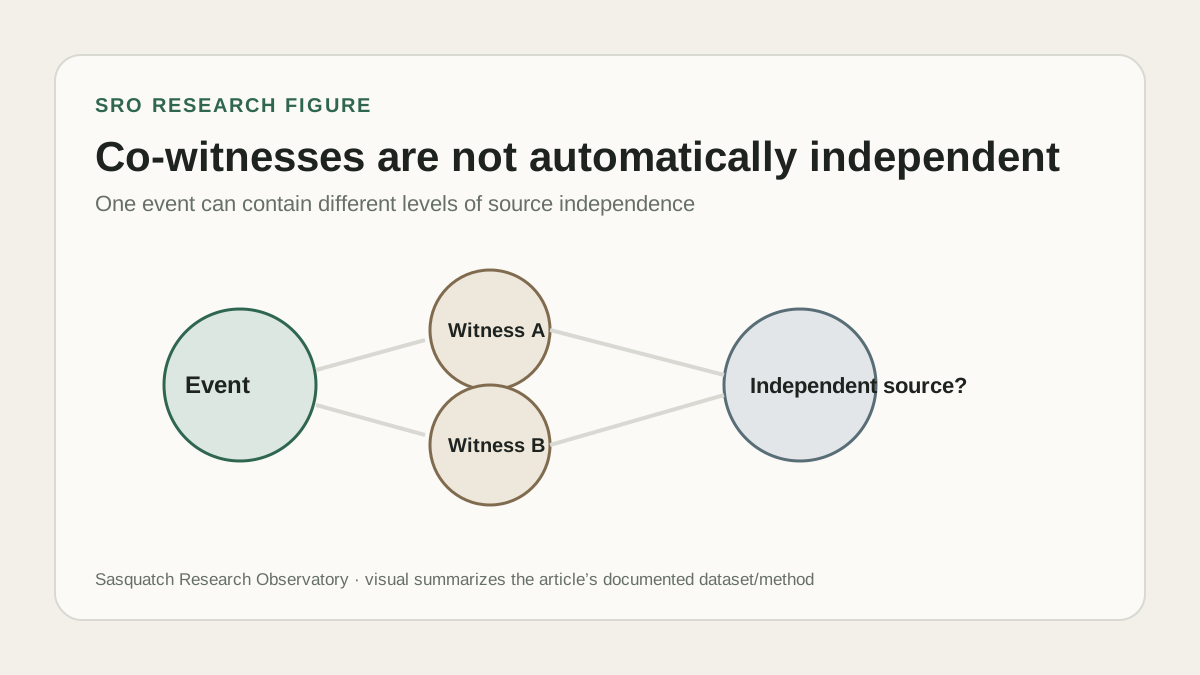
'Four people saw it' sounds like four separate confirmations. In an archive, however, that statement can describe very different evidence: four independently preserved accounts, one group report, or one witness saying that three other people were present. SRO now treats those situations differently because the number of names in a story is not automatically the number of independent testimonies in the record.
Inspect the underlying media
These source items are tied to witness or case records cited in this publication. They are provided for inspection and remain separate from the article’s analysis.
Open original source
Original source
Source material associated with this witness record. Inclusion documents the source trail and does not authenticate the underlying claim.
Open original source ↗Media / source record
Original source
Source material associated with this witness record. Inclusion documents the source trail and does not authenticate the underlying claim.
Open original source ↗Scope of this publication
- This is a methodological publication illustrated with 3 archive examples, not a survey of every multi-witness case.
- Current examples distinguish reported witness count from independently recoverable testimony.
- Exact source anchors include LOC-0005 and LOC-0008; some co-witness sources remain recovery targets.
- Reproducibility: finding ANL-4.5-003 plus linked event/witness/source records.
Presence and independence are different questions
A source can establish that several people were identified as witnesses without preserving what each person independently said. SRO therefore records reported co-witnesses at the event level, while reserving independent concordance for cases where another witness's own recoverable statement, interview, report or comparable source exists.
Three examples show the distinction
Todd Neiss has described Jeff Martin's reaction during the 1993 Oregon National Guard encounter, but an independent Martin statement has not yet been recovered in the current source layer. Sara Brown has reported that a neighbor also saw a subject, while that neighbor's own statement remains pending. The 1973 Big Muddy police file identifies four carnival workers and preserves a group summary, but not four separately worded statements.
Those records can still support the narrower fact that an event was reported as involving multiple people. What they cannot yet support is treating every named person as a separate, independently preserved confirmation of the descriptive details.
Why this changes how strong cases are described
Without this control, a single narrative can appear to multiply into several confirmations simply because additional names occur inside it. Separating event witness count from independently sourced witness count prevents that inflation and makes missing evidence visible.
It also produces a concrete research task: recover the other witness's own statement. When that happens, SRO can compare agreements, differences and possible information-sharing rather than assuming concordance in advance.
What this article does—and does not—conclude
This is a methodological finding demonstrated by three archive examples. It does not conclude that multi-witness Sasquatch reports are generally dependent, nor does it discount contemporaneous group documentation. It establishes the evidentiary rule the larger dataset will use when future publications analyze corroboration rates.
Inspect the underlying work
- Finding ID: ANL-4.5-003
- Examples: Todd Neiss / Jeff Martin; Sara Brown / reported neighbor; Big Muddy carnival-worker group
- Exact locators include LOC-0005 and LOC-0008
- Status: methodological control established; independent co-witness source recovery remains open