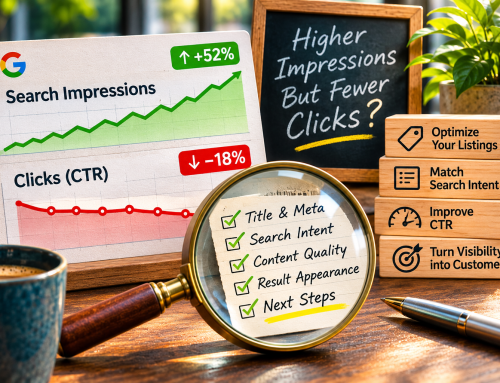

Should a small business pay extra for generative engine optimization (GEO) or AI search optimization? Sometimes a focused test makes sense. But a separate monthly GEO package should earn its place alongside the work that already helps customers find and contact you. The question is not whether AI search exists. It is whether an additional investment will produce useful, measurable business outcomes.
A sensible starting point is to distinguish three things: appearing in an AI-generated answer, receiving a visitor from that answer, and gaining a qualified inquiry or customer. They are not interchangeable. A business can be mentioned frequently without receiving much traffic, and a smaller number of visits can still matter if they come from people ready to hire.
What are you actually buying when someone sells GEO?
GEO is a broad marketing label, not a single technical service. One proposal might cover better service descriptions, original evidence, clearer business information and technical accessibility. Another might promise AI citations through a proprietary trick. The first set of improvements can be useful regardless of where the visitor comes from; the second deserves close scrutiny.
Google’s own guidance says its AI search features use familiar SEO fundamentals, including indexable pages, accessible text, internal links and accurate structured data. It does not require special AI files or a special schema to qualify. That is not proof every AI platform behaves identically, but it is a strong reason to ask what additional work a GEO vendor will actually perform.
For a practical foundation, review our SEO and local search services and the separate guide on making a website more visible in AI search. Those explain the underlying improvements. Here, the decision is whether to spend additional money on a dedicated program.
Use four questions before approving a GEO budget
1. Is your current search and website foundation working?
Check whether your important service pages are indexed, explain the work clearly and lead to a functioning inquiry process. Look at Search Console impressions and clicks for commercially relevant pages, then compare those with actual inquiries. A site that has missing service pages, broken forms or unclear location information may have more urgent work than tracking AI mentions.
Consider a hypothetical plumbing company whose emergency service page receives search impressions but very few visits. Before paying for a new AI campaign, it might make more sense to review the page title, the service description, local relevance and the path to requesting help. That is not a promise of better rankings; it is a way to address an identifiable weakness first.
2. Do your buyers use AI to choose providers?
AI can be useful for research and comparisons, but its role varies by industry and buying situation. A person comparing software or complicated professional services may ask several detailed questions. Someone needing an urgent nearby repair may go straight to a map, phone number or familiar referral. Do not assume the same discovery journey for every business.
Ask recent customers how they found you when it is appropriate and easy to do. Review referral sources in analytics, but recognize that some AI-assisted discovery may not be separately attributable. A few test prompts can reveal what an AI system says on a particular day; they cannot establish a stable ranking or reliable market share.
3. Can the proposed result be measured?
Ask a vendor to define the outcome before work starts. Is it an AI citation, a brand mention, an attributable referral, an engaged visit, a completed contact form, or a qualified lead? Ask which platforms and prompts are sampled, how often, and whether the sampling process changes between reports.
Keep the measurement layers separate. Search Console is useful for Google search performance, but totals can include different search appearances and privacy-limited query rows. Analytics can show some referrals and conversions, but referral attribution is incomplete. A CRM or inquiry ledger can confirm whether a lead was genuine. A screenshot showing your business in one AI response is evidence of that response, not proof that the campaign paid for itself.
4. What else could the same money improve?
The useful comparison is not GEO versus doing nothing. It is GEO versus your best available alternative. That might be improving an important service page, fixing a mobile usability problem, strengthening local business information, documenting actual projects with permission, or improving customer intake. Compare expected effort, evidence, reversibility and how soon you can check results.
A modest experiment may be justified when the foundation is healthy and a real buyer question is underserved. A large retainer is harder to defend when the vendor cannot explain the deliverables or connect them to meaningful customer actions.
A simple decision test: invest, test or defer
Invest in focused improvements when the proposed work solves a documented content or technical gap and helps customers whether they arrive from Google, AI tools or another source. Require a specific scope and clear ownership of the finished content.
Test cautiously when AI discovery looks plausible but business impact is uncertain. Pick one service area and a short, defined evaluation period. Record the baseline, make a small number of substantive improvements, then compare comparable periods while noting low volume and reporting delays. Do not call a handful of mentions a statistically reliable gain.
Defer a separate GEO package when the site has obvious conversion or search problems, the sales pitch relies on secret markup, or the reporting measures only a vendor-controlled visibility score. Defer does not mean ignore AI search. It means improve the underlying business information before adding another recurring expense.
What to ask a GEO provider before signing
Request an itemized description of the pages, technical checks, original research or business information they will improve. Ask what is different from normal SEO work, whether they will edit existing pages or create new ones, and how they will avoid duplicate content. Require access to the actual deliverables, a clear cancellation arrangement and reporting that distinguishes visibility from leads.
Watch for promises of guaranteed AI recommendations, undisclosed networks of artificial mentions, or reports that present a changing set of prompts as consistent growth. No reputable provider controls whether an AI system chooses to cite a particular business. Even legitimate improvements may take time to be discovered and may not produce a measurable result.
What a useful 30-day baseline looks like
Start with a small worksheet: your top three service pages, their current search visibility, the number of attributable inquiries, known AI referrals where identifiable, and any genuine customer feedback about discovery. Record the date and data source. Then identify one question buyers regularly ask that your website does not answer well.
If you make a change, document precisely what changed. Revisit the same pages and measurement definitions after a reasonable interval; do not treat the first few days as a verdict. For low-volume small businesses, the honest result may be inconclusive. That is still useful information when deciding whether to expand spending.
The broader point is straightforward: AI discovery deserves attention, but attention is not the same as an unlimited budget. Build a site that clearly explains your work, measures genuine inquiries and gives people a reason to trust you. Add specialized GEO spending only when it addresses a specific opportunity that your existing SEO and website work do not already cover.
If you want help sorting out the highest-value website and search improvements before adding another marketing expense, request a discovery conversation.
Built in collaboration with ChatGPT.