The short answer: only when each page helps someone make a decision
A business serving several nearby towns does not automatically need a separate website page for every town. A location page is useful when a customer in that place has a specific question the general service page does not answer well. It becomes a problem when the only difference is a swapped city name. That approach can create repetitive pages without adding meaningful information for the person searching.
Before building a batch of city pages, identify the services you actually deliver, the areas you genuinely cover, and what a visitor needs to know before contacting you. A good local page makes those answers easier to find. A weak one makes the website larger without making it more useful.
Start with the customer question, not a list of ZIP codes
Imagine a home-service company that works in three neighboring municipalities. A visitor might reasonably ask whether the company serves their neighborhood, whether travel charges apply, which services are available there, or whether an appointment can be scheduled in their area. Those are meaningful questions. A page that answers them with accurate details may be worthwhile. A page that repeats the same generic sales pitch with three different city headings does not solve them.
Write down the top questions you receive from customers in each area. If the answers are essentially identical, a single well-organized service-area page with a clear list of covered locations may be better. If the answers differ in material ways, consider whether a dedicated page would make those differences easier to understand.
Use a four-part test before approving a city page
1. Is the service genuinely available there?
Confirm that the business actually serves the location and can fulfill the offer described. Do not imply that you maintain a staffed office, local team, or physical storefront where none exists. A service-area business can describe where it travels without pretending to operate a separate location. If the service is limited by distance, appointment type, or scheduling, say so plainly.
2. Is there information specific to that area?
Useful differences might include a service boundary, a locally relevant process, a specific type of property served, a documented project with permission to describe it, or accurate logistical considerations. The difference should be real, current, and relevant to a buying decision. Do not manufacture neighborhood expertise, client results, testimonials, or local projects to make a page appear distinctive.
3. Does the page answer a question the main service page misses?
A visitor should be able to understand what is offered, where it is offered, any meaningful limitations, how the process works, and how to request help. If the general service page already answers all of those questions clearly, adding a city page may not improve the experience. Instead, improve navigation or add a concise service-area section to the existing page.
4. Can the page stay accurate over time?
Every new page becomes another item to maintain. If service coverage, contact details, offerings, or operating procedures change, outdated city pages can mislead customers. Assign someone responsibility for reviewing them. If the business cannot maintain a dozen accurate pages, three useful pages are preferable to twelve nearly identical ones.
What a useful city service page can include
Begin with a direct explanation of the service and the area covered. Follow with information that genuinely matters to local customers: applicable service types, availability boundaries, what to expect during an inquiry, and any legitimate differences from other locations. Include an easy route to the main service details and a clear contact option. The page should work on a phone and should not force the visitor to hunt for the next step.
A useful local example can be hypothetical when labeled that way. For example, a hypothetical landscaping company may offer recurring maintenance in one town but only larger installation projects farther away. Explaining that distinction saves a customer time. By contrast, replacing the city name in the same paragraph twenty times does not create twenty genuinely useful pages.
For a broader explanation of how local search fits into a small-business website, see our practical local SEO guide. If you are evaluating ongoing support, our SEO and local search services page explains the related work without suggesting that city pages are automatically necessary.
Watch for doorway-style patterns
Google’s spam policies identify doorway abuse as pages or sites created to rank for specific, similar search queries that lead people to essentially the same destination without adding distinct value. That does not mean every location page is prohibited. It means the purpose and usefulness of the pages matter. Pages built mainly to capture variations of town names, with thin repeated copy and no unique purpose, deserve particular scrutiny.
Review a proposed group of pages side by side. Remove the city names and ask whether the remaining information is substantially identical. Then ask whether a visitor would be disappointed to land on any one of them. These are editorial checks, not an official Google scoring formula, but they expose the practical risk of producing pages for search engines rather than customers.
Choose the simplest architecture that solves the problem
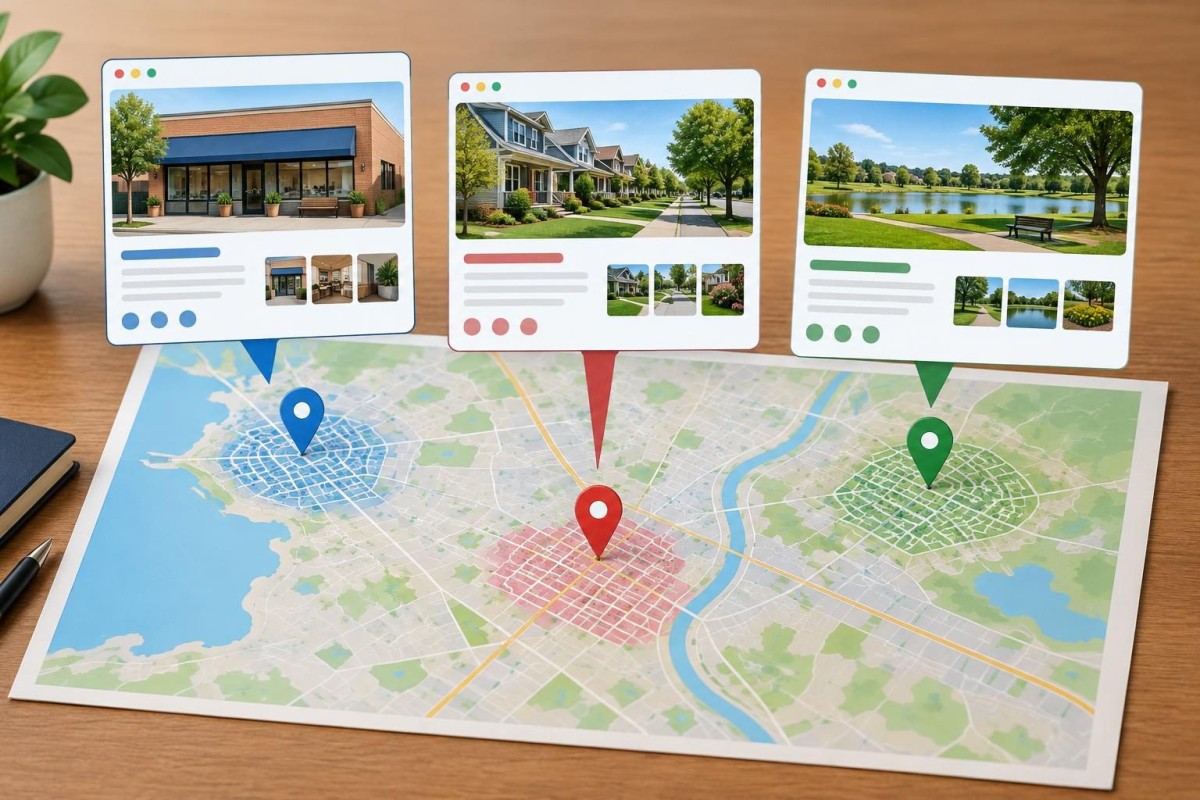
There are three sensible options. One comprehensive service-area page can list genuinely served towns and explain any geographic limits. A primary service page can contain a short coverage section and link to a service-area overview. Or a small number of distinct city pages can provide deeper local information where it is actually warranted. The right choice depends on customer needs, not on how many town names a keyword tool produces.
Keep navigation straightforward. Avoid burying customers in a giant city menu or creating near-identical pages that compete for the same query. Use descriptive internal links where they help a reader move between service details and coverage information. Make sure the business name, address presentation, and contact details are truthful and consistent with how the business actually operates.
A 30-minute decision exercise
Select the three towns most relevant to the business. For each, write one sentence explaining the customer’s likely question, one sentence describing what is materially different there, and one sentence explaining what action the page would help the visitor take. If you cannot complete the second sentence with a real fact, do not commission a separate page yet. Put the location on an accurate service-area page instead.
Next, inspect your existing website. Search for the town name, review the main service page, and follow the contact path on a phone. If the information is already clear, prioritize other improvements. If important details are missing, decide whether a targeted section or a new page is the least complicated way to fix them. Finally, review the result as a customer would: can someone tell whether you serve them and what happens next?
If you want help deciding whether your site needs a service-area overview, a few genuinely distinct local pages, or a simpler navigation change, request a discovery conversation. The goal is a useful website, not a bigger page count.
Built in collaboration with ChatGPT.