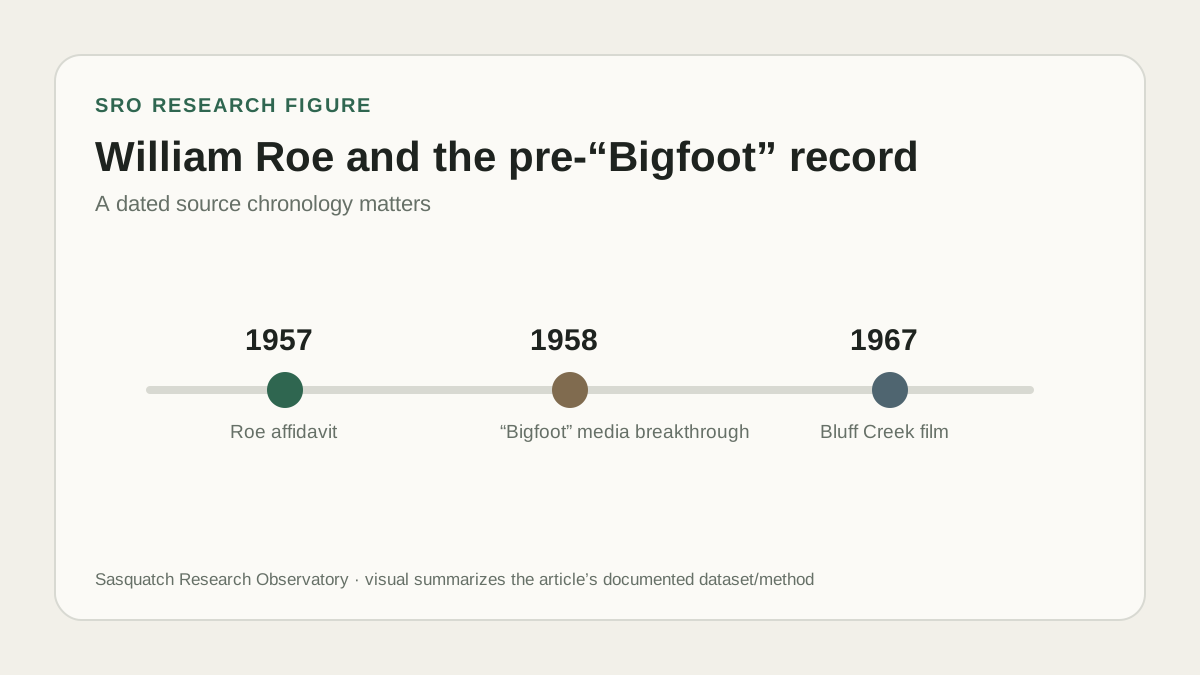
The strongest way to test whether a familiar Sasquatch trait was borrowed from later culture is not to ask when an encounter supposedly happened. It is to ask when the description can actually be shown to have entered the public record. William Roe’s account gives the Observatory an unusually useful early anchor.
Inspect the underlying media
These source items are tied to witness or case records cited in this publication. They are provided for inspection and remain separate from the article’s analysis.
William Roe 1957 sworn affidavit reproduction
Sasquatch Chronicles
Document scan connected to this witness record. It is presented as documentation, not as independent authentication of the reported event.
Open original source ↗Scope of this publication
- Encounter reported by Roe: 1955.
- Earliest recoverable public source used by SRO: 1957 sworn affidavit.
- Usable coverage: four morphology/locomotion traits traceable directly to that early source.
- Traits coded from that source: long arms; short/thick neck; broad/massive build; bipedal gait.
- Source mix: this article intentionally uses the 1957 primary sworn account as the chronological anchor; later reproductions are not treated as independent attestations.
- Independence: this is an attestation-date test, not a claim that Roe was culturally isolated from all earlier folklore.
- Provenance strength in audit: Very strong.
- Limitation: earliest recoverable public attestation is not necessarily Roe’s earliest private statement and does not authenticate the encounter.
- Reproducibility: event H-ROE-1955 × four coded trait fields in the early-attestation provenance ledger.
The date that matters is 1957
Roe said his encounter occurred in British Columbia in 1955. For provenance analysis, however, SRO anchors the traits to the earliest recoverable public source located in the audit: a 1957 sworn affidavit. That distinction matters. Encounter dates can be remembered or reported retrospectively; a surviving dated source tells us when particular wording was demonstrably documented.
Several familiar traits are already there
The 1957 record describes arms reaching almost to the knees, a short thick neck, a huge broad body and upright walking. Those are not reconstructed from a modern podcast or a later summary. They are the trait fields SRO can trace to the early source itself.
Why the timing is interesting
The well-known northern California newspaper use of “Bigfoot” followed in 1958. Roe’s document therefore gives the research program a pre-breakthrough attestation for several morphological traits that later became culturally familiar. That does not prove later witnesses were independent of all earlier folklore, nor does it authenticate Roe’s encounter. It narrows one specific cultural-contamination argument: these particular descriptions were publicly documented before the 1958 media moment.
Roe is an anchor, not a verdict
A single early document cannot establish what Sasquatch is—or whether Roe saw an unknown animal at all. Its value is chronological. It allows later morphology claims to be compared against a dated baseline instead of against a vague idea of what people “used to say.”
Inspect the underlying work
- Witness: William Roe
- Historical anchor: 1957 sworn affidavit
- Trait-provenance audit: four early-attested morphology/locomotion fields
- Caution: earliest recoverable is not necessarily earliest private statement