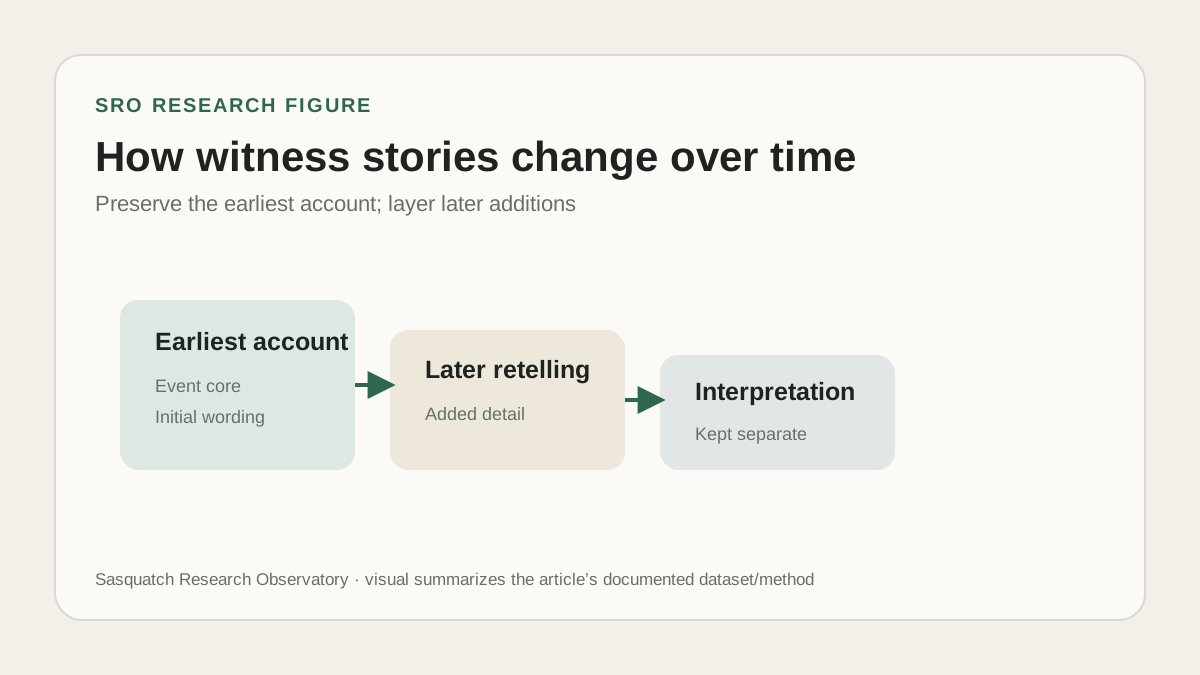
A witness can tell the same basic story for years and still add things later. That sounds contradictory until the account is separated into layers: the event sequence, the physical description, later evidence claims and later interpretation. SRO tested that approach on a ten-witness source-audit pilot.
Inspect the underlying media
These source items are tied to witness or case records cited in this publication. They are provided for inspection and remain separate from the article’s analysis.
Don’t Shoot the Bigfoot! - Episode 214
My Bigfoot Sighting
Audio / transcript associated with this witness record. Source access is preserved separately from evidentiary assessment.
Open original source ↗
Bob Gimlin at Patterson/Gimlin Film Site Interview (Short Version)
Tate Hieronymus / Bluff Creek Project
Video associated with this witness record. Source access is preserved separately from evidentiary assessment.
Open original source ↗Scope of this publication
- Pilot sample: 10 core witnesses, 5 modern + 5 historical.
- Usable coverage: longitudinal stability is only assessed where at least two recoverable source layers exist; single-account witnesses remain not testable.
- Source mix: firsthand podcasts/interviews, sworn or written accounts, contemporaneous press/official reporting and later firsthand retellings depending on the witness.
- Unique-source rule: independently produced firsthand accounts only; mirrors/reposts do not create source depth.
- Independence: separate publications are not automatically independent testimony; the audit tracks unique firsthand source layers rather than raw appearance counts.
- Stability requires ≥2 recoverable source layers; ≥3 across a long span is a stronger longitudinal opportunity.
- Contradiction means incompatible claims, not ordinary elaboration.
- Evidence authenticity is assessed separately from testimony consistency.
- Limitation: a public-source audit cannot guarantee recovery of every statement ever made.
- Reproducibility: witness-level source-audit rows preserve earliest recoverable account, source depth, stability fields, accretion and contradiction coding.
The audit asked a different question
Instead of assigning a single credibility score, the pilot reconstructed the publicly discoverable source history for five modern and five historical core witnesses. Mirrors and reposts were not counted as new firsthand sources. The audit then compared core-event stability, morphology stability, later detail, contradictions and interpretive accretion.
John Nance shows why chronology matters
John Nance had two recoverable firsthand public accounts in the pilot. His initial Colorado encounter and roughly ten-foot scale remained stable across the 2024 and 2026 retellings on the comparable core dimensions. That makes the case useful for longitudinal comparison without implying that consistency proves the event happened as described.
Historical cases show different kinds of change
William Roe’s morphology is effectively fixed by the preserved 1957 document, while later reproductions mostly repeat that source. Bob Gimlin’s core event and broad morphology remained strong across firsthand interviews separated by decades. Paul Freeman’s core physical subject remained broadly stable while later track and film claims expanded the evidence story. Fred Beck’s physical core remained broadly stable while metaphysical interpretation grew later. These are different kinds of change and should not be collapsed into a single “consistent/inconsistent” label.
The practical finding
The audit supports a methodological rule rather than a sensational conclusion: preserve the earliest recoverable account, compare later sources field by field, and classify additions separately from genuine contradictions. A detail appearing later is not automatically false. But it should never be silently backdated into the earliest version of the story.
Inspect the underlying work
- Dataset: Witness exhaustive source audit — 10-witness pilot
- Examples: John Nance, William Roe, Bob Gimlin, Paul Freeman, Fred Beck
- Output categories: core-event stability, morphology stability, detail accretion, contradiction, interpretive accretion
- Status: methodological finding; not a credibility ranking